Why AI Hallucinates in Hotels — and How a Truth Layer Fixes It
AI hallucinations are often described as a quirky limitation of large language models: the system says something that sounds plausible, but isn’t true. In hospitality, that “quirk” becomes a liability. A wrong answer about late check-out, parking fees, pet policies, breakfast hours, or accessibility is not just an incorrect response—it is the hotel publicly misrepresenting itself.
As AI in hospitality becomes part of the discovery journey, the stakes rise. Travelers increasingly ask AI assistants to compare properties, summarize what a hotel offers, and recommend the “best option” for their needs. These systems respond with confidence, and they do it before a guest ever reaches your website. That makes hallucinations in hotel AI systems more than a technical issue; they become a trust issue with direct operational, reputational, and commercial consequences.
What a “Hallucination” Really Means in a Hotel Context
In general AI research, hallucination refers to generated content that appears coherent and confident but is not grounded in verifiable facts. A hotel example is painfully simple: a model that claims a property has a spa because it has seen many hotels described that way; or an AI that “fills in” a check-out time because it seems typical; or a system that merges conflicting sources without acknowledging uncertainty. Surveys on hallucinations emphasize this core risk: LLMs can produce fluent text that is not faithful to reality, which creates reliability challenges in real-world deployments.
The defining hospitality problem is not that AI sometimes makes mistakes. It’s that when it makes mistakes, it does so in a tone that feels authoritative—and the guest has no way to tell it’s wrong.
Why Hotels Are a Perfect Hallucination Factory
Hotels are a data environment built for contradictions. A property’s “truth” is scattered across formats and systems that were never designed to be reconciled: PDFs created years apart, seasonal rules, internal SOPs, OTA descriptions, Google Business Profile fields, and web pages edited by different people at different times. Even when information is “correct,” it is often context-dependent. Breakfast hours may change on weekends. Pool access may differ by season. Cancellation rules may vary by rate plan. Accessibility details can be nuanced.
For an AI model, this looks like ambiguity. When it doesn’t have a single trustworthy answer, it doesn’t stop; it predicts.
This is not a moral failing of the model. It’s the design of the technology. Language models are trained to generate the most likely continuation of a prompt. When the system lacks strong grounding, the “most likely” answer can easily become a confident fabrication. Hallucination surveys describe this as a structural reliability challenge that must be addressed with governance, evaluation, and mitigation—not wishful thinking.
Why “Just Use RAG” Is Not Enough
Many teams respond to hallucinations by adding Retrieval-Augmented Generation (RAG): instead of answering from the model’s internal memory alone, the system retrieves relevant documents and then generates an answer using that retrieved context. RAG is a major step forward in modern AI system design and has a strong research foundation.
But “basic RAG” is not the same thing as “trustworthy hotel truth.”
In hospitality, the hardest part is rarely retrieval. The hardest part is authority. If your retriever pulls two documents that disagree—an old brochure and a new policy—RAG does not automatically know which one is the official truth. If the retriever pulls something “related” but not definitive, a model can still fill gaps with plausible language. Even hallucination research highlights that retrieval-augmented systems can still hallucinate and that mitigation requires careful system-level design, not a single technique.
So the real question becomes: what tells the system what to trust?
The Root Cause: No Authority, No Accountability
Most hotel AI systems fail in the same way: they are not governed. They do not have a well-defined “source of authority,” and they do not make uncertainty visible. The result is a black box—especially for AI for hotel managers who need predictability and control.
A manager doesn’t just need an answer. They need to know:
Is this answer verified?
Which source produced it?
Is that source current?
What happens when sources conflict?
What does the AI do when it doesn’t know?
If the system cannot answer these questions, the manager cannot safely delegate.
This is where the concept of a Truth Layer matters.
What Is a Truth Layer in AI for Hotels?
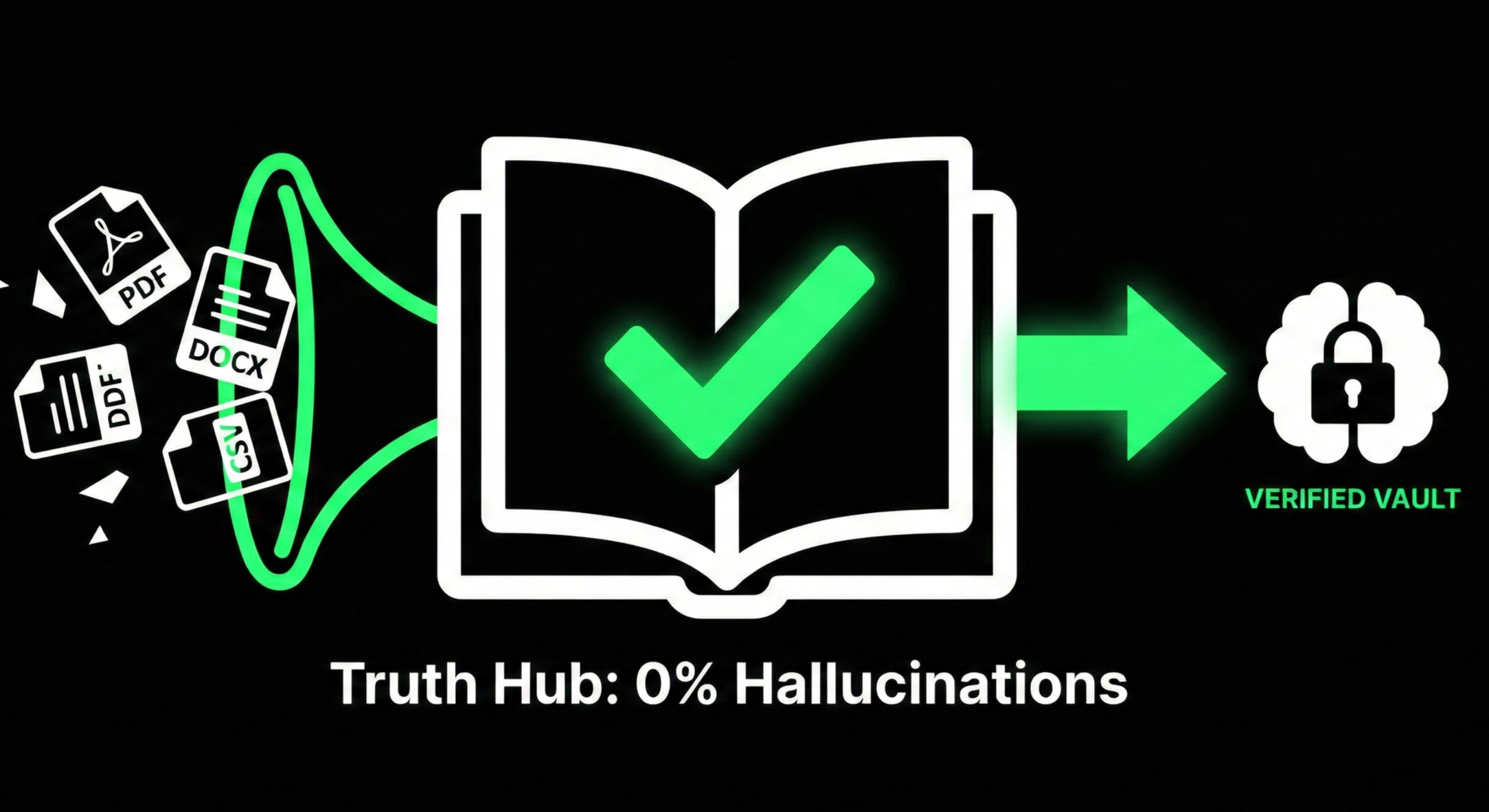
A Truth Layer is a governed knowledge foundation that defines what is “true” for a specific hotel and enforces that truth inside AI behavior. It is not just a document folder, and it is not just RAG. It is a set of rules and controls that turn messy information into an operationally reliable reference.
A practical way to think about it is: the Truth Layer is the hotel’s “digital constitution.” It defines what sources are allowed, which ones are authoritative, and how the system must behave when certainty is low.
This approach aligns with broader best practices in AI risk management: trustworthy AI systems require governance, transparency, and risk controls across the lifecycle—not only model performance. The NIST AI Risk Management Framework provides a strong cross-sector lens for thinking about these controls, and NIST has also published companion guidance focused on generative AI risks and management.
What a Truth Layer Enforces (The Non-Negotiables)
A real Truth Layer changes system behavior in three fundamental ways.
First, it enforces source authority. Not all documents are equal. A current internal policy should override an old public brochure. A verified SOP should outrank a marketing page. Without a hierarchy, the AI is left to guess which source to follow.
Second, it enforces traceability. Every public-facing answer should be auditable: the system can point to the exact source that supports the response. This is the difference between “AI that sounds right” and “AI you can trust.”
Third, it enforces restraint. In hospitality, the best answer is sometimes: “I don’t have verified information for that yet.” That sentence is not a failure; it is a protection mechanism.
The result is not slower AI—it’s AI that is safe to scale.
“I Don’t Know” Is a Feature in Hospitality
One of the biggest mindset shifts for teams deploying AI in hospitality is learning to value uncertainty. When a model improvises, it creates risk. When a system acknowledges a gap, it creates a task: update the truth.
This is where the Truth Layer becomes a management tool. It turns hallucinations into signals. If a guest asks about parking fees and the system cannot answer from verified sources, that is not an embarrassing moment—it is a precise operational gap to close.
Why This Matters Specifically for Hotel Managers
Hotel managers do not adopt AI because it is interesting. They adopt AI because they want fewer repetitive decisions, fewer operational surprises, and fewer brand risks. That’s why AI for hotel managers must be governed by design.
Without a Truth Layer, managers spend their time reviewing AI output with skepticism. With a Truth Layer, managers can review AI output with confidence because they can see where it came from and why it is safe.
This is the difference between AI as an intern and AI as a trained staff member following policy.
A Practical Self-Audit: Are Hallucinations Inevitable for Your Hotel?
If you want a quick reality check, ask four questions:
Where is the official truth for policies, hours, amenities, and exceptions stored today? If the answer is “everywhere,” hallucinations are likely.
If two sources disagree, do you know which one is authoritative? If not, your AI won’t know either.
Can your system show a source for its answers? If not, it’s not governed.
When the system doesn’t know, does it stop—or does it guess? If it guesses, hallucinations are not a risk; they are guaranteed.
Truth Layers and “Machine-Readable Hospitality”
There’s a second benefit to Truth Layers that many teams underestimate: they are the foundation of machine-readability. Hotels increasingly need structured, consistent information so search engines and AI systems can interpret them reliably. Schema.org provides guidance for marking up hotels, which is a key piece of making hotel information more machine-readable.
Google also provides explicit documentation for hotel-related structured data (including hotel price structured data), reinforcing the direction of travel: machine-readable data improves understanding and accuracy in automated systems.
A Truth Layer is not the same as schema markup, but they reinforce each other. The Truth Layer governs correctness and authority internally; structured data helps external systems interpret your hotel consistently.
The Bottom Line
AI hallucinations in hotels are not solved by “better prompts,” and they are not solved by adding a chatbot on top of messy data. They are solved by building hotel AI systems that know what is authoritative, can prove it, and can refuse to guess.
That is what a Truth Layer provides.
It is the first building block of responsible AI in hospitality—and it is the reason AI can become a trusted decision-support layer for hotel teams rather than a risky black box.
Insightful Resources
Retrieval-Augmented Generation (RAG), foundational paper. (arXiv)
Hallucination survey (taxonomy, causes, detection, mitigation). (arXiv)
NIST AI Risk Management Framework (governance + trustworthiness). (NIST Publications)
NIST Generative AI Profile (practical companion for genAI risk). (NIST Publications)
Schema.org hotel markup guidance (machine-readable hospitality). (Schema.org)
Google hotel structured data documentation (price/accuracy context). (Google for Developers)